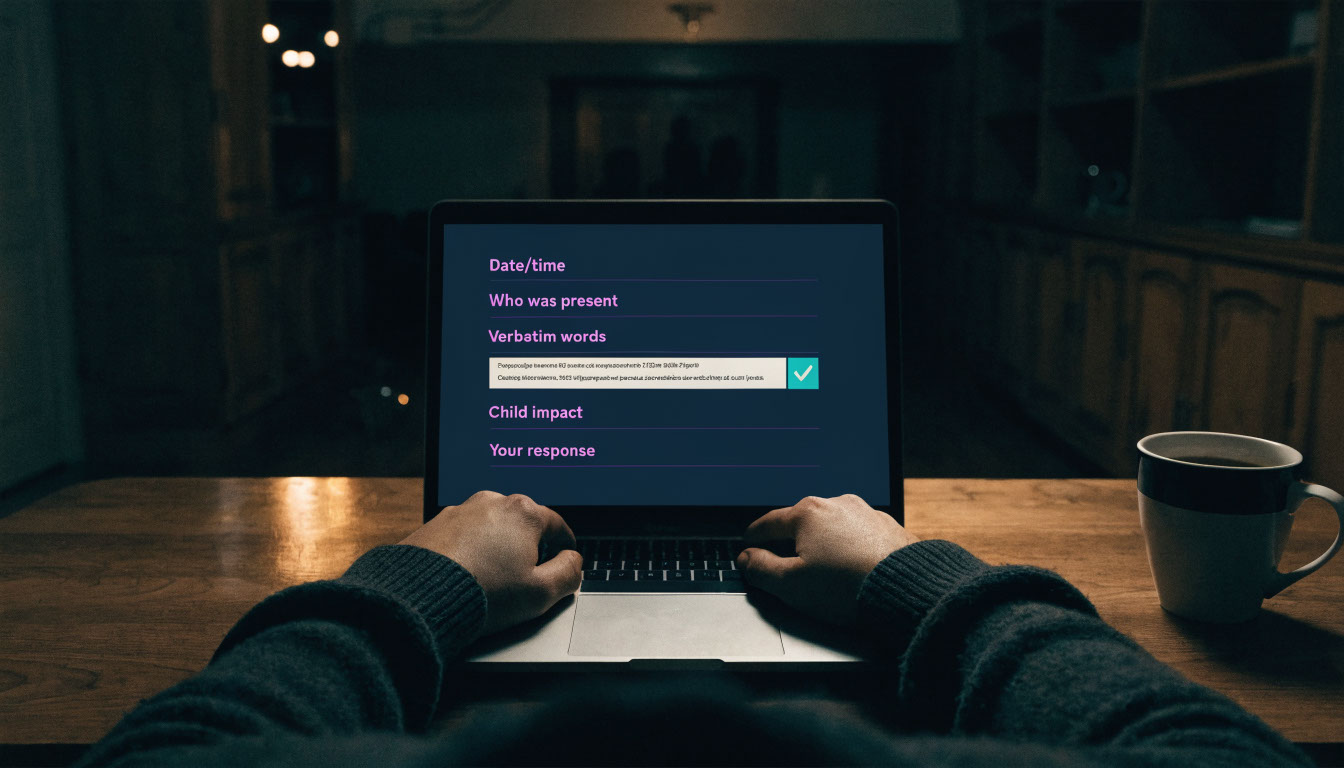
What to include in a custody log: 5 things lawyers need
Most parents log the wrong things. Here's what your lawyer actually needs in every custody entry — and what makes one entry stronger than another.
When you walk into your attorney’s office with a folder of screenshots and a stack of notes, they’ll spend the first twenty minutes of your billable hour organizing what you brought. At typical family-law billing rates, that’s $100+ of legal time spent on filing, before any actual legal work begins.
What your lawyer actually wants is a custody log built for the way courts read evidence: timestamped, specific, verbatim, and pattern-ready. Most parents, even careful ones, log the wrong things.
This guide covers the five elements every custody log entry needs, why each one matters to a judge, and what the difference looks like between a weak and a strong version of the same incident.
What courts read, and what they ignore
Not all documentation is weighted equally in court. Contemporaneous notes (entries made at or near the time of an event) carry significantly more weight than after-the-fact reconstructions. This isn’t a technicality. It’s how evidence law treats memory. (See, e.g., Federal Rules of Evidence Rule 803(5), governing recorded recollections; state evidence rules follow similar principles.)
Judges and family law attorneys know that memory degrades. They know that under high-conflict stress, the brain’s ability to encode specific details is impaired. A custody log made in real time is treated as a record of what happened. A custody narrative written six months later is treated as the reader’s best current recollection, which by definition has gaps.
This is the frame that makes the five elements matter. Each one increases the evidentiary weight of an entry by anchoring it in specifics that can be cross-examined and verified. The goal isn’t to write more. It’s to write entries that hold up under scrutiny.
1. Date and time, exact
Specificity is what makes an entry usable. “Last Tuesday at pickup” cannot anchor a pattern, cannot be cross-referenced against the parenting plan, and reads as reconstruction rather than contemporaneous record.
The strong version: “Tuesday, April 21, 2026, 5:23pm.” The exact date locks the entry to your court order’s schedule. The exact time lets you demonstrate compliance or deviation with precision.
You don’t need to log every entry to the minute. Some incidents (a comment heard during a phone call, a behavior observed at a school event) happen without you checking a clock. In those cases, log the closest you can: “approximately 7:15pm during the school’s spring concert.” Specific approximation is stronger than vague accuracy. Never round to “evening” when “around 7:15pm” is available.
2. Who was present
Witnesses change the weight of an entry. A documented exchange in front of your child carries different evidentiary force than a documented exchange that happened in a private conversation.
For every entry, name the people who were physically present and could corroborate what happened. The categories that matter most:
- Your child: when the incident involves the child’s exposure to conflict, the child’s experience is central to the court’s analysis
- Third parties: grandparents, school staff, neighbors, coaches, anyone who can independently verify what occurred
- Service providers: therapists, doctors, teachers, especially when they witnessed something relevant
When your child reports something to you about time spent with the co-parent, document the report without leading the child. “Mia said, on the drive home, that her father told her she would have to choose which parent to live with” is documentation. “I asked Mia about her father, and she confirmed he is pressuring her” is leading, and custody evaluators and Guardians ad Litem (GALs) — court-appointed advocates for the child — are typically trained to flag this pattern.
3. Verbatim words
Paraphrase is harder to defend. “He said hurtful things in front of our child” can be challenged as your interpretation. “He said, in front of M (8): ‘Tell your mom she’s always making things harder than they need to be’” cannot.
Quote exact words in quotation marks. If you can’t remember the precise wording, say so explicitly: “He said something close to: ‘I’m not driving across town just because she wants this.’” This is more credible than fabricating precision you don’t have.
Verbatim quotes serve three purposes in custody proceedings. They prevent your characterization from being impeached. They demonstrate to a court that you’re a careful observer who values accuracy over emotional shorthand. And they capture the specific tone (sarcasm, threat, manipulation) that paraphrase smooths out.
This applies to text messages and emails too. Don’t summarize them in your log. Quote the relevant lines directly, or attach the screenshot with a timestamp. Both is better than either.
4. What the child experienced or said
Custody outcomes turn on the child’s best interest, not the parents’ conflict. An entry that captures the child’s specific experience is weighted differently from an entry that only captures adult-to-adult conflict.
Compare these two ways of logging the same incident:
The conflict at exchange was upsetting for our daughter.
M (8) waited in the parking lot for 23 minutes past the agreed time. When J arrived and made the comment quoted above, M became quiet. On the drive home, she asked whether she had done something wrong.
The first entry tells the court the child was upset. The second shows what the child experienced and how she responded. That’s the material a judge, a GAL, or a custody evaluator can actually use.
Document what the child did, what the child said, and what the child’s demeanor was. Don’t interpret. “She seemed traumatized” is interpretation; “she didn’t speak for the rest of the drive and asked twice whether the next visit could be canceled” is documentation.
5. Your response
What you did is part of the record too. Custody decisions consider both parents’ co-parenting conduct. An entry that documents your measured, responsible response is part of the record a custody evaluator or judge will consider when assessing each parent’s conduct — the same way an entry documenting the other parent’s behavior is part of theirs.
This is the element most parents skip. They log what the co-parent did and not what they did about it. But the record is incomplete without your side. What you did about an incident is itself documentable: “I did not respond,” “I redirected M to her room,” “I drafted a response and chose not to send it,” “I logged the comment in this entry instead of replying.”
The strong version of this element is usually one sentence. “I did not respond to J in front of M; I logged the comment in this entry instead.” Or: “I drove M home, talked with her once we were inside, and contacted my attorney the following morning.”
Side-by-side: weak vs. strong
The same incident, a late pickup with a comment in front of the child, logged two ways.
Weak version (12 words):
Apr 21 — J was late to pickup again and was rude in front of M.
Strong version (138 words):
April 21, 2026 — 5:23pm pickup at the agreed exchange location (the school’s main parking lot, per the current parenting plan). J arrived at 5:23pm; the agreed time was 5:00pm. M (8) had been waiting in the lobby with me since 4:50pm.
When J got out of the car, he said in front of M: “Tell your mom she’s always making things harder than they need to be.” M became quiet. On the drive home, M asked whether she had done something wrong. I told her she had not.
I did not respond to J in front of M. I logged the comment in this entry. The current parenting plan does not include a late-pickup remedy; I have noted the time for pattern tracking and will discuss with my attorney whether the cumulative late record warrants action.
Same incident. The weak version is twelve words and could describe a hundred different events. The strong version anchors a specific moment in a specific child’s life, documents both parents’ conduct, and shows the user’s own measured response.
That’s the difference between a log entry and an evidence entry.
How Verascribe Guardian structures this
The structure isn’t decoration. You choose a category — communication, health, schedule, and so on — and Verascribe surfaces the relevant fields for that type of entry. Timestamps are automatic. The five elements from this guide map directly to how the log is built: who was there, what was said verbatim, how your child responded, what you did next. Each entry is organized for the kind of review your attorney, a custody evaluator, or a judge will put it through.
That means no twenty-minute organizing tax at the start of your next meeting. The log is already in the format your lawyer expects.
Every entry is part of a cryptographically-verified chain — each entry’s fingerprint includes the one before it. If any entry is added, removed, or edited after the fact, that chain no longer matches, and the workbook flags it when you export. When the authenticity of your records comes into question, that’s the difference between “these notes” and “these notes where any alteration would be detected and flagged at export.”
Here’s what most custody apps don’t tell you: every other tool in this space stores your logs on their servers. That means a company you don’t control has access to your most sensitive family records. Verascribe works differently. Your log lives in your own Google account — your Google Drive, your data, your control. Verascribe never holds your records, never sees them, and can never hand them over to anyone. The co-parent has no access. Neither do we.
What you have now
You have a five-element checklist that turns any moment of co-parenting friction into an entry your lawyer can use. Date, presence, verbatim, child impact, your response.
Most of the entries you log will be ordinary: a missed exchange, a passive-aggressive text, a comment at handoff. The pattern that matters won’t be visible until you have months of them.
This week, pick the last five entries in your current log (whatever you’re using) and audit them against the five elements. Note which elements are missing from each. The next time you log, write the entry as if the audit had already happened.
The case is built one entry at a time.